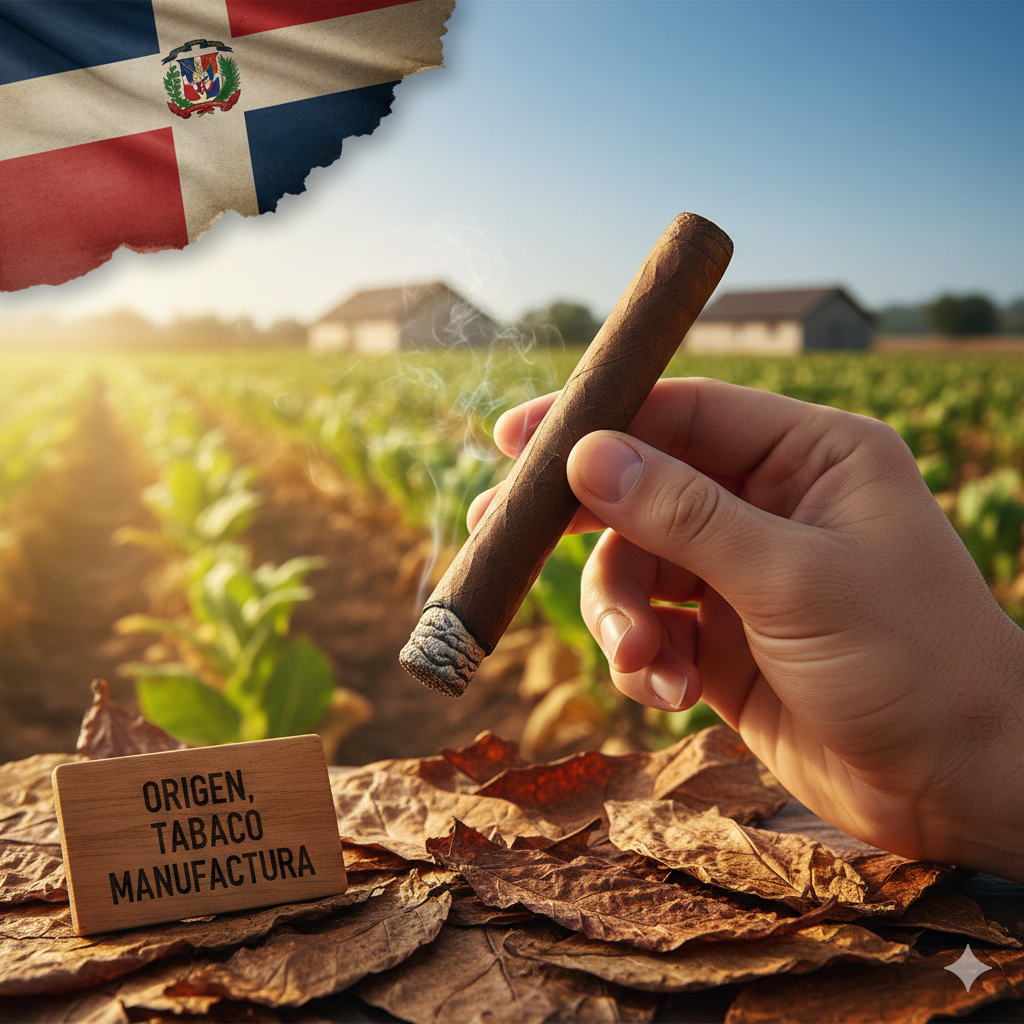

Discussing Dominican tobacco without discussing regions reduces the subject to a label.
The country produces a complex agricultural system where soil composition, humidity, altitude and generational expertise determine structural and sensory outcomes.
The key concept is terroir.
Understanding Dominican terroirs explains the country’s sustained leadership in premium cigar production.

What Is Terroir in Tobacco?
In tobacco production, terroir integrates:
- Mineral soil composition
- Altitude
- Relative humidity
- Average temperature
- Rain patterns
- Wind exposure
- Traditional cultivation practices
These variables influence:
- Oil concentration
- Natural sugar levels
- Leaf thickness
- Elasticity
- Fermentation stability
- Combustion performance
The Dominican Republic benefits from remarkable year-to-year consistency in these factors.
Cibao Valley — Structural Epicenter
The Cibao Valley is the country’s primary tobacco corridor.
Key attributes:
- Alluvial mineral-rich soils
- River-fed irrigation from Yaque del Norte and Yuna
- Mountain protection
- Stable humidity

Impact on tobacco:
- Natural sweetness
- Floral aromatics
- Balanced medium body
- Even combustion
Common varietals:
- Piloto Cubano
- Olor Dominicano
- San Vicente
Documented Producers with Regional Presence
- Arturo Fuente maintains agricultural operations within the Cibao region, including farms historically linked to Dominican wrapper development.
- Davidoff (through Tabadom in the Dominican Republic) has documented proprietary agricultural programs and seed development in the Cibao.
- Tabacalera de García operates in the northern corridor and maintains structured agricultural sourcing programs in the region.
Note: Not all operations imply direct land ownership; several companies operate through integrated agricultural programs or contractual farming models.
La Vega Real — Mineral Depth
Located within the Cibao, La Vega Real features:
- Deep mineral soils
- Strong moisture retention
Leaf characteristics:
- Higher oil content
- Superior elasticity
- Strong fermentation response
Often valued for binder and selective wrapper production.
Agricultural and Industrial Presence
- La Aurora has historically documented tobacco sourcing and cultivation within the broader Cibao region near Santiago.
- Independent growers cultivating Piloto Cubano and Olor supply multiple factories located in Santiago.
Note: La Vega Real functions primarily as an agricultural subregion within the greater Cibao system.
Villa González — Dominican Wrapper Reference
Recognized for wrapper cultivation.
Conditions:
- Balanced sun exposure
- Fine leaf texture
Impact:
- Clean combustion
- Delicate aromatics
- Cream-driven profiles
Historically linked to premium wrapper development.
Premium Wrapper Operations
- Davidoff (Tabadom) has developed agricultural projects focused on Dominican wrapper production in Villa González.
- Local growers supply wrapper-grade tobacco to factories in Santiago and Tamboril.
Note: Land ownership structures vary between corporations and independent farmers.
Tamboril — Industrial and Agricultural Integration
Tamboril combines:
- Concentrated manufacturing infrastructure
- Skilled rollers
- Proximity to farmland
Associated profile:
- Soft spices
- Wood notes
- Rounded medium body
It represents the integration of field and factory.
Established Manufacturing Facilities
- La Aurora operates manufacturing facilities in Tamboril.
- La Flor Dominicana maintains factory operations in the area and agricultural ties in northern Dominican Republic.
- Quesada Cigars operates from Tamboril.
- La Galera Cigars has manufacturing installations in the locality.
Note: Tamboril’s primary relevance is industrial rather than agricultural.
Navarrete — Aromatic Structure
Produces leaves with:
- Earth-driven notes
- Dark sweetness
- Fermentation stability
A region blending tradition with modern experimentation
Agricultural Corridor
- Independent growers in Navarrete supply factories in Santiago and Tamboril.
- The area forms part of the historic Cibao tobacco corridor documented by local industry associations.
Note: Major brands do not uniformly declare direct farm ownership in Navarrete; contractual farming is common.
La Canela — Density and Strength
Known for:
- Greater sun exposure
- Dense soils

Impact:
- Higher oil concentration
- Structural strength
- Spiced profiles
Suitable for fuller-bodied blends.
Documented Agricultural Operation
- La Flor Dominicana has publicly documented ownership and operation of farms in La Canela used for higher-strength tobacco production.
Note: This region presents one of the clearest examples of direct agricultural ownership by a premium brand.
Bonao — High-Performance Wrapper Development
Relevant for wrapper cultivation achievements.
Attributes:
- Structural resilience
- Optimal elasticity
- Clean aromatics
Demonstrates the country’s capacity to produce competitive wrapper leaf.
Dominican Wrapper Development
- Arturo Fuente developed agricultural projects in Bonao enabling successful high-performance Dominican wrapper cultivation.
- The region is referenced in discussions regarding modern Dominican wrapper development.
Note: Bonao is technically significant for wrapper development rather than industrial concentration.
Editorial Conclusion
Dominican tobacco regions form an integrated agricultural system.
Each contributes measurable variables:
- Density
- Sweetness
- Elasticity
- Combustion stability
- Structural strength
Understanding these terroirs is fundamental to understanding Dominican cigar architecture.
Agricultural structure sustains industrial credibility.